
Causal AI
Causal Artificial Intelligence distinguishes between correlation and causation. Correlation is not causation. It is not necessary that everyone who smokes will get cancer, but that is what the present day AI modules may predict. Correlation based AI applications make a prediction based on ‘what’ has happened and not ‘why’ it has happened.
If we do not know the root cause, we could easily make poor decisions and support ineffective and prejudicial policies and judgements. Root cause analysis has to do with causation: with providing an answer to the question why an incident happened, rather than to the question: what, where, and how much.
Causal models are mathematical models representing causal relationships within an individual system or population. They facilitate inferences about causal relationships from statistical data: the relationship between causation and probability.
FMEA and FTA establish the relationship between failure cause and its effect. The probabilistic relation between cause and effect is determined through Critical Analysis (CA). A Bayesian Network (BN) is a graphical model representing the joint probability distribution P(X) on a set of random variables X = {X1, …, Xn} defining probabilities P ∈ [0,1] for each possible state (x1, …, xn) ∈ X1,dom, …, Xn,dom where Xi,dom is the domain of definition of each variable.
FMECA/FTA are used primarily for the reliability of system operation or equipment to keep it always functional, while BN is used to diagnose a system when it is facing failure and also to predict it in order to avoid its appearance. We have transformed an FMECA/FTA to a BN. The structure of the BN is derived from the effects, causes and failure modes present in the FMECA/FTA.
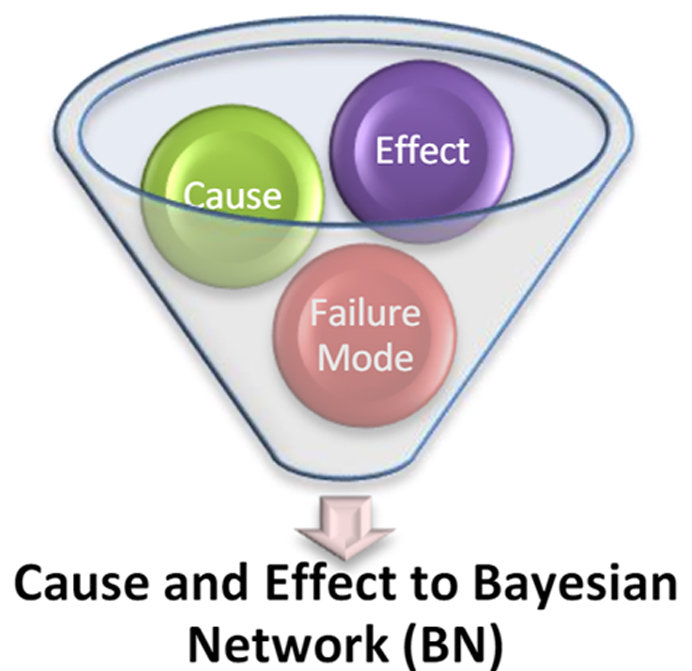
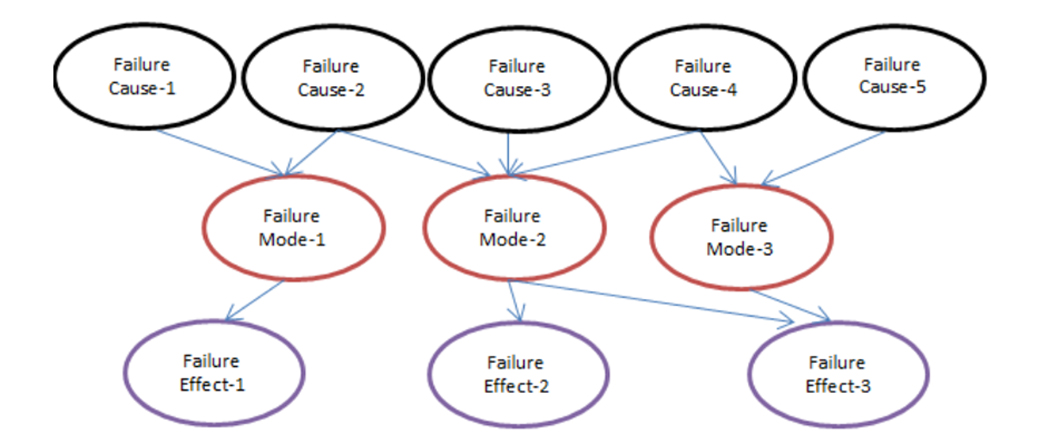
In this BN, we utilise the following two scenarios. In the first, we suppose that there is a failure and we want to identify its causes. Here the diagnosis makes it possible to explain the causes of failures by back chaining in the BN. In the second scenario, we suppose there is no failure in the equipment, but we want to know the probability of the consequences given that the causes of failures are known in advance. So we predict them by front chaining in the BN.
We at Reliability Centre India are linking the FMECA/FTA to BN.